
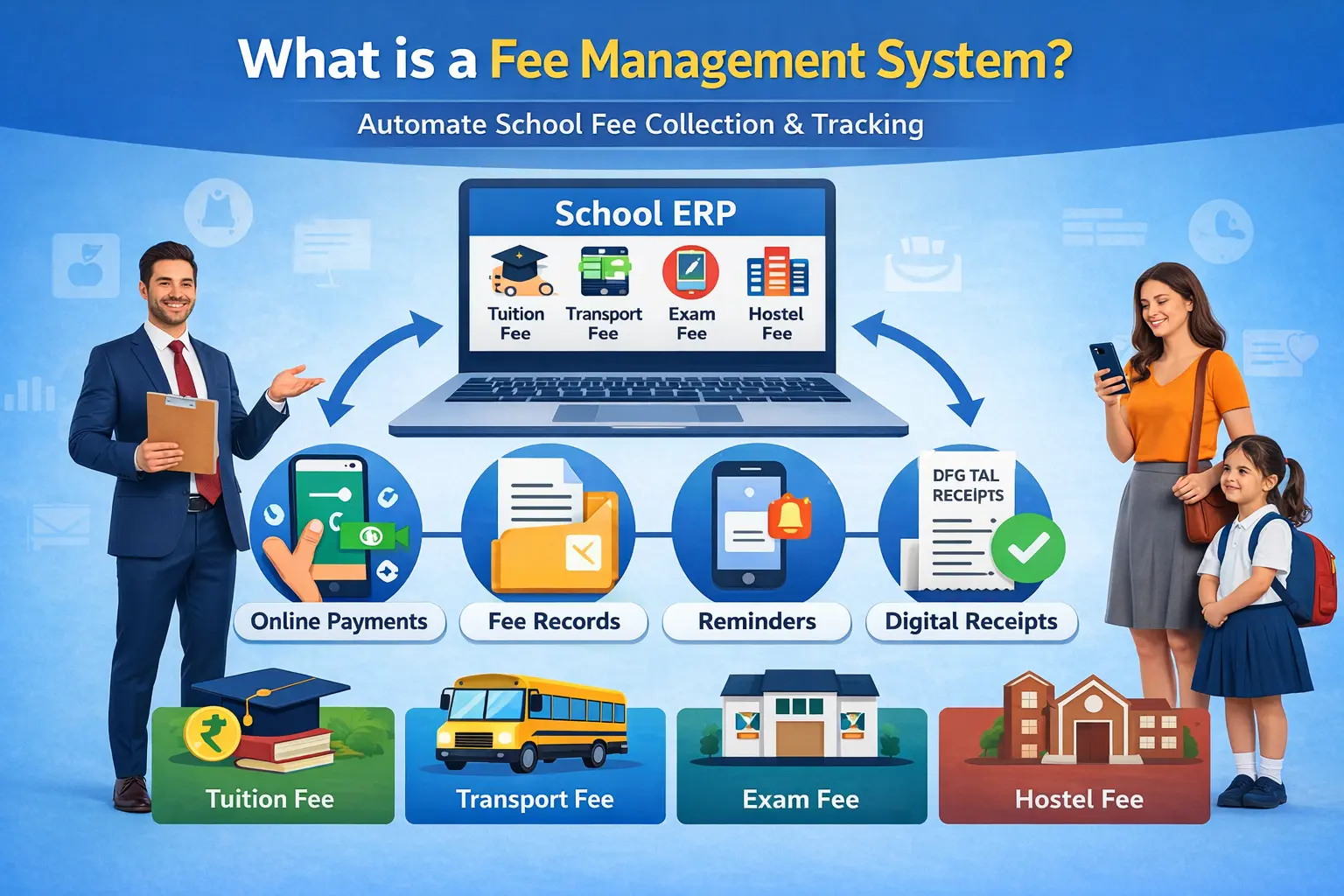
What is a Fee Management System?
Managing school fees is one of the most indispensable administrative functions in an educational institution. Up until a few years ago, many schools, especially the smaller ones, used to handle fees and payments through manual registers, paper receipts, and spreadsheets. However, with the explosive growth in the number of school-going children in the country, this approach becomes inefficient to manage.
A Fee Management System a best feature with school management system that allows educational institutions to automate the entire process of collecting, tracking, and managing student fees. It is usually integrated with a School ERP software, which helps in connecting the school administrators, teachers, parents, and students in one single platform.
A digital fee management system allows schools to handle the various types of fees that a student would need to pay, such as tuition fee, admission fee, exam fee, library fee, transport fee, hostel fee, activities fee, etc. The system automates the recording of payments to help the school maintain accurate financial records without manual interventions.
This system makes it easier for parents to see fees, payment history, and due dates from an app or website. Most services let parents even pay fees using UPI, debit/credit cards, and digital wallets. Overall, the fee management system makes it easier for schools to collect fees.
Before digitization, schools were completely reliant on several manual fee systems, and while it worked for smaller schools, it caused problems for bigger institutions.
Possibly the biggest problem with manual fee collections is people. Staff may mistakenly enter the wrong amounts and associate the wrong payment to the wrong student account.
Another problem is records. Paper documents can be misplaced, and the bottom of the record book is neglected. Staff may spend an extended amount of time looking for documents.
With manual systems, the school payment counters build up long lines. Handling parents' manually and needing to go to the school wastes time and creates crowding, especially for pay days.
Each administrator may track which payments have come in and which haven't, and may have to call parents before it is up to date.
If there are no systems in place to keep track of records, it can also mean fraudulent changes to records.
As a result, fee management systems have become a viable option.
Key Features of School Fee Management Software
Most modern ERP systems have a lot of flexibility when it comes to fee management and also help reduce the workload of the school.
Automated Fee Generation
Fees are calculated automatically based on class, session, or student category, so administrators don't need to do it manually every time a student is added.
Online Payment Integration
Most fee management systems have secure Payment Gateway integrations, which means parents can pay using UPI, net-banking, debit, credit cards, and even digital wallets.
Automated Reminders and Notifications
Fees are set to automatically send generated reminders to parents, and notifications can be SMS, Email, or mobile application notifications.
Digital Receipts
The moment a payment is made, a digital receipt is generated by the system in real-time to both, parents and administrators, and can be accessed at anytime by both parties.
Multiple Fee Categories
Schools can handle multiple fee categories from the same dashboard like tuition fee, transport fee, hostel fee, exam fee, library fee, etc.
Real Time Dashboard
Administrators can view the collection of fees in real time. The dashboards display total fees received, amounts still to be paid, and other financial data.
These features aid schools in simplifying financial processes and enhancing efficiency.
Benefits of an Online Fee Management System
The introduction of an online fee management system presents numerous benefits to schools, parents, and administrators.
Saves Time for the School Staff
Manual calculations and record keeping consumes a great deal of time and energy. With automation, the repetitive processes of record keeping and calculations are done and staff are left to handle more complex and important administrative duties.
Ease for Parents
There is no longer the need for parents to come to the school to pay the fees. They can settle all the payments via a a mobile phone or computer from the comfort of their home or even while at their workplace.
Less paperwork
A digital system eliminates the need for paper slips, registers, and manually compiled files. This helps schools in their progression to a paperless system.
Better Transparency
Parents are provided with detailed information regarding their child’s fee structure, payment records, and outstanding amounts. This transparency reinforces the confidence parents have in the school.
Keeping Records Correctly
The system keeps all transaction digitally, ensuring all records, data, and information are kept error free and complete.
Collection of Fees
Payments can be made online at any time and payments are received instantly by the school, which improves the school’s cash flow.
This makes it clear why the systems are crucial.
What the Process of Fee Management looks like. A fee management process has certain steps it follows to ensure the collection of fees is quick and easy.
Step 1: Fee Structure Setup
The admin sets up fee heads like tuition, transport, exams, and fees for using the library. These are assigned to classes and groups of students.
Step 2: Automatic Fee Generation
After the structure of the fees is set, invoices are automatically created by the system based on the students placement.
Step 3: Parent Notification
Parents are informed of the due fees by SMS, Email, or Mobile App. Notifications are sent with the amount, the last day to make the payment.
Step 4: Paying Your Fees
Parents can use the online school portal or the school app to pay fees. Some schools allow offline payments in cash or by check, which can be entered into the system.
Step 5: Generating Your Receipts
Once payment has been processed, the system automatically updates your payment record and generates a receipt.
Step 6: Maintaining Your Records
The entire transaction history is kept by the system in the database, where it is available to administrators upon request.
The entire process is intended to help schools collect fees without the need for a collection agent.
Flexible Fee Structures
Each school has its own unique fee policies based on school type, available facilities, and categories of students. A high-quality fee management system allows school administrators to design fee policies according to specific needs.
The fees for transport, for example, can be set according to distance or route.
The system can also accommodate specific rules for students who receive scholarships, discount prices for students who are siblings, and fee exemptions for students who are less fortunate. Fee structures can be defined for specific classes, academic terms, or departments. For example, senior classes may have higher fees for exams and labs than for junior classes.
This software's flexibility allows it to mold to a school's financial policies rather than requiring the school to alter the way it does business.
Reports and Analytics for Better Decision Making
An additional strong benefit afforded by the fee management software is its capability to report and analyze data.
Financial reporting and the analysis of data related to the collection of school fees can be made by the admin of the school.
Reports that are most commonly used are:
Total fees collected in a period of time
Reports of fees that are pending because of defaulting
Summaries of fee collections by class
Reports of the payment method used whether it be cash, online, or cheque
Financial reports that are monthly and yearly
The school management can make financial decisions with the help of the reports generated by the school fee collection system. If a large number of students make delayed payments, the school can change the payment calendar and set reminders in the system.
Because of the system's ability to store documents in an organized manner, auditing and financial compliance is made responsive and easy.
The systems of fee management that are used today apply the most sophisticated methods to ensure that financial data is kept safe.
Payment data is made safe by the methods used in data encryption. The payment gateways that are used are in compliance with legal banking norms that are applicable to them.
Another helpful feature is role based access control. Only some staff members can see and make changes to financial records. This authority leaves less room for mistakes.
Technical issues can cause the loss of data. Regular data backups can avoid this.
Many systems also integrate tax compliance and GST where applicable. This ensures government regulations and improves financial reports.
When these systems are used, schools can manage finances more.
Conclusion
The smooth operation of any educational institution depends on managing school fees efficiently. Manual methods of collecting fees involve a lot of errors, delays, and administration issues.
The entire process is simplified by a Fee Management System as it automates fee generation, payment tracking, reminders, and reporting. Parents feel more convenient, school staff work less, and financial records are accurate.
Features like data management, customized fee structures, secure data management, and real time dashboards bring improvements to the collection of fees.
Financial transparency is brought by a Fee Management System integrated with the School ERP System.
A smart step towards modern school administration is considering solutions such as ERP SchoolAura for simplifying fee collection, reducing paperwork and improving financial management.