
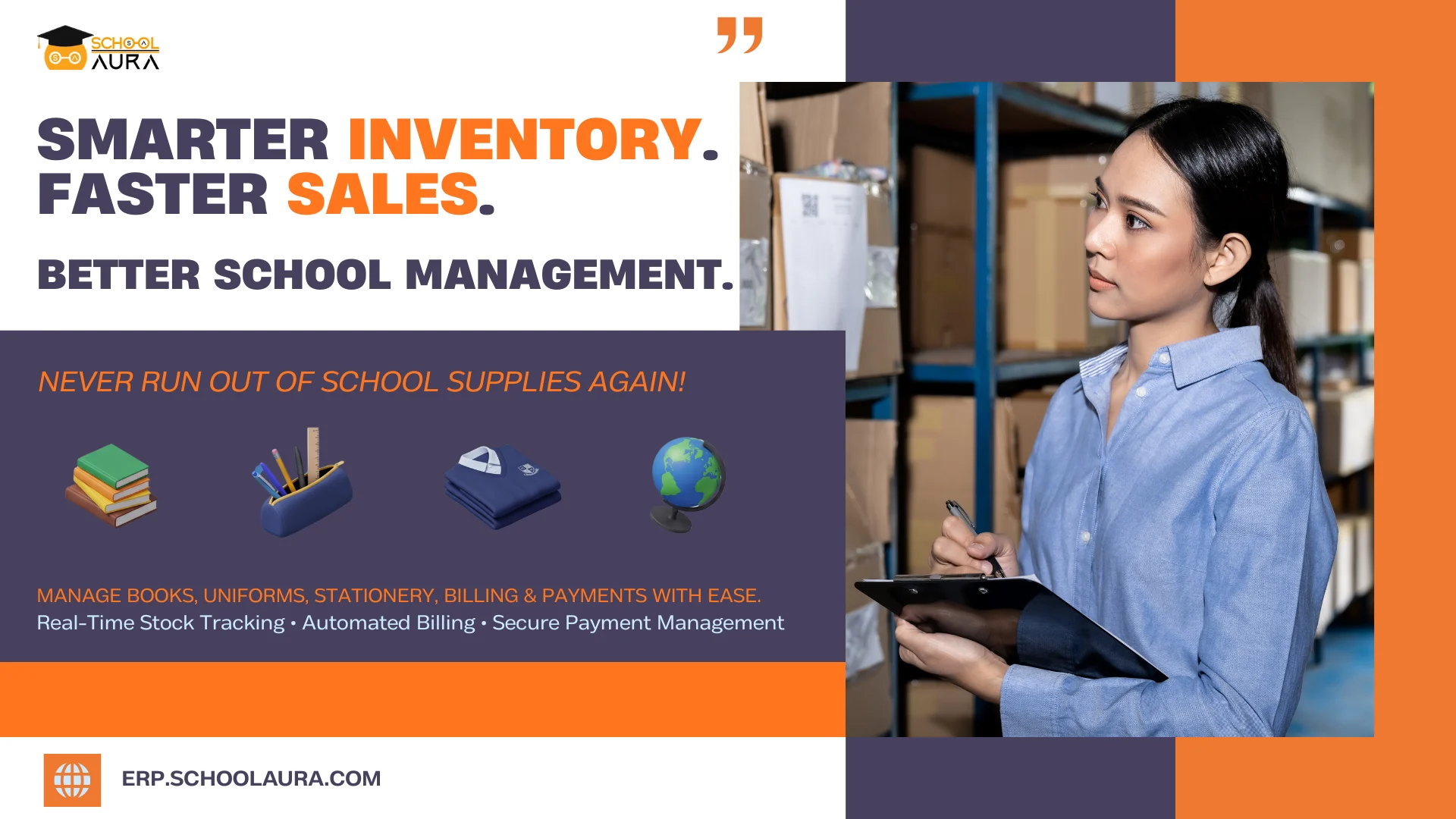
Why Schools Struggle to Manage Sales and Inventory Without School Management Software
See how school management software helps schools manage inventory, automate sales, track stock, and improve administrative efficiency with ease.
#school management software #school erp #school management system #school erp software
22 Jul, 2026Schools now manage a wide range of resources on a daily basis. From books, uniforms, stationery, and lab materials to various student and also staff-related purchases and payments, handling inventory and sales operations has become an important part of school administration. However, for many schools, especially growing institutions, managing inventory and sales manually can quickly become difficult and time-consuming.
Limited storage space, increasing student strength, manual record-keeping, and disconnected systems often create challenges such as stock shortages, billing errors, misplaced records, and delays in tracking payments. During admissions or the beginning of a new academic session, these issues become even more noticeable as schools handle large volumes of inventory distribution and sales activities simultaneously.
Proper inventory and sales management play a major role in keeping school operations organized and efficient. When schools lack a centralized system, even small mistakes in stock tracking or billing can create unnecessary workload for staff and inconvenience for parents. Overtime these mistake also stresses school finances if it keeps happening. This is where a school ERP comes into the picture, it helps schools track inventory in real time, manage product sales, generate bills instantly, maintain accurate payment records, and automate routine administrative tasks through a single platform.
In this article, we will explore the importance and benefits of school management software in the areas of school inventory and sales management and how this solution can help schools improve efficiency, reduce manual work, and create smoother inventory management across the board.
The Increasing Importance of Digital Management in Schools
Handling large numbers of students also means managing uniforms, books, stationery, ID cards, fee records, and many other resources on a regular basis. Every activity requires proper coordination, tracking, and record management.
When schools depend completely on manual processes, common issues often start affecting daily operations, such as: Inventory shortages, Duplicate data entries, Billing and calculation mistakes, misplaced or missing records, delays in payment tracking, and difficulty monitoring stock availability
Even a single operational problem among these can create unnecessary pressure for school staff and lead to inconvenience for parents as well.
Real-Life Scenarios Where School ERP Improves Inventory Management
1. Inventory Tracking
Imagine the beginning of a new academic session in a school. Hundreds of parents and students are arriving to collect books, uniforms, ID cards, and stationery. The administrative staff is busy checking registers, updating spreadsheets, and manually counting stock. Within a few hours, confusion starts building up. Some items appear available in records but are missing in storage, while others run out unexpectedly.
With a school ERP software, this entire process becomes much smoother. As soon as an item is issued to a student, the inventory updates automatically in real time. Administrators can instantly check how many uniforms, books, or notebooks are still available without physically verifying stock again and again. This helps schools avoid shortages, maintain accurate records, and manage inventory more efficiently throughout the year.
2. Automation
Think about a school administrator who spends hours every week updating inventory records manually. Every purchase, every distributed item, and every stock adjustment has to be entered separately into registers or spreadsheets. Even a small typing mistake can create confusion later. Now imagine the same school using a school management software.
Whenever a student purchases a book or receives a uniform, the system updates the stock automatically without any manual effort. Bills are generated instantly, payment records are stored securely, and inventory reports are updated in real time. Instead of spending time on repetitive tasks, staff members can focus on more important school responsibilities while the software handles routine inventory management automatically.
3. Streamlining School Operations
During annual functions, examinations, or admissions, schools often require large amounts of supplies and materials within a short period of time. Without proper inventory management, staff may struggle to locate required items or discover shortages at the last moment. For example, if examination materials or stationery are not tracked properly, schools may face unnecessary delays and last-minute arrangements.
A school management software helps avoid such situations by keeping inventory records organized and updated continuously. Staff members can quickly check what resources are available, what has already been used, and what needs to be arranged. This improves coordination between departments and helps daily school operations run more smoothly.
4. Forecasting, Restocking, and Managing Surplus Inventory
Consider a situation where a school suddenly runs out of notebooks or ID cards during admissions. Since there was no proper tracking system, administrators were unaware that stock was running low. As a result, urgent purchases had to be made at higher costs. With school ERP software, low-stock alerts can notify administrators before supplies are exhausted.
Schools can plan purchases in advance and maintain the right inventory levels throughout the academic year. At the same time, the system also helps identify extra or unused stock. For instance, if a large number of old uniforms or unused materials remain in storage, administrators can take action before resources go to waste.
ERP Systems Help Schools Save Money
Many schools use separate systems for inventory management, billing, student records, and administration. This often increases workload, creates duplicate work, and consumes more time and resources. Imagine a school where staff members manually manage inventory, prepare bills separately, and maintain different records for purchases and stock updates. The process not only takes longer but also increases the chances of mistakes and unnecessary expenses.
With an integrated school ERP system, everything works together on a single platform. Inventory updates, billing, reporting, and payment tracking happen automatically and accurately. Schools can avoid over-purchasing, reduce paperwork, and improve operational efficiency. Over time, these small improvements help schools save money, reduce administrative stress, and create a more organized working environment for both staff and management.
Supporting Convenient Payment Options
Today, parents expect faster, simpler, and more flexible ways to make any payments. Modern sales management systems make this possible by offering multiple payment methods, including:
- Cash
- UPI
- Online bank transfers
- Debit/Credit Cards
This gives parents the convenience of choosing their preferred payment option without standing in long queues unnecessarily, only for payment. At the same time, schools can maintain accurate financial records, as all transactions are now digitally recorded and easily available for future audits.
Conclusion
Managing school inventory and sales manually may have worked in the past, but today’s schools handle far more than just books and uniforms. As educational institutions continue to grow, managing stationery, ID cards, lab equipment, sports materials, student purchases, and payment records through manual processes becomes increasingly difficult and time-consuming.
Modern schools need smarter systems that can simplify daily operations and reduce administrative pressure. A digital sales and inventory management system helps schools maintain accurate records, automate billing, track inventory in real time, and improve transparency across departments through one centralized platform.
That's it for now. I hope you enjoyed reading this blog. Don’t forget to check out more of our blogs for more interesting content. For any other questions, just contact us with any queries related to our school management software.